
Muriel Grossfeld · Part 3
By: Bruce A. Davis, Professor Emeritus Miami Dade College. Copyright 2021
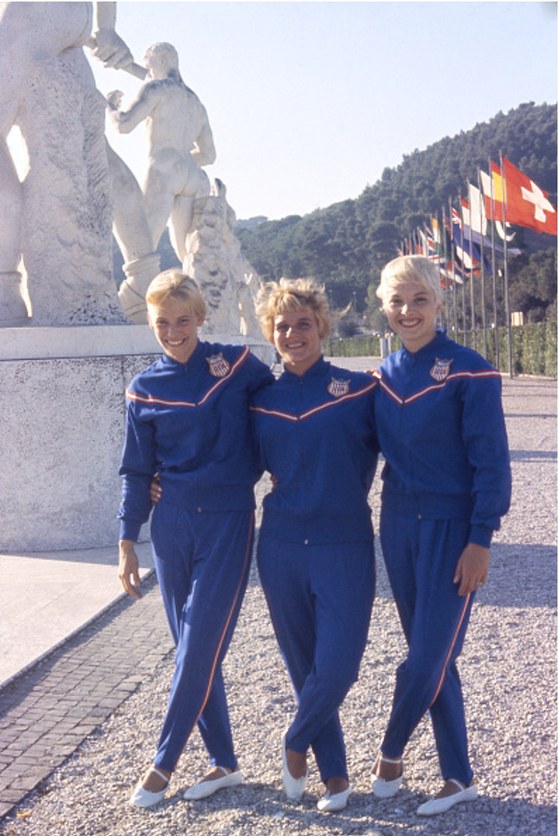
The 1960 Rome Olympic men’s and women’s teams from Russia and Japan each individually toured the United States with the respective US teams during 1961. Muriel tied Russia’s Larisa Latynina, the 2-time Olympic all-around champion and soon-to-be three-time Olympic floor exercise champion, for first place in floor exercise and third place on balance beam during a dual meet at West Chester State College. Muriel’s teammate Doris Fuchs Brause won the uneven parallel bar event. Muriel and Doris were rewarded with an appearance on the Ed Sullivan Show in New York City.
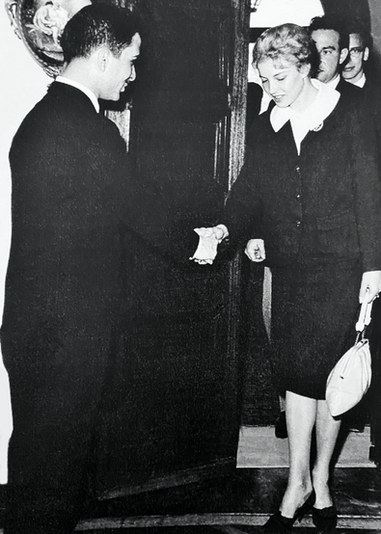
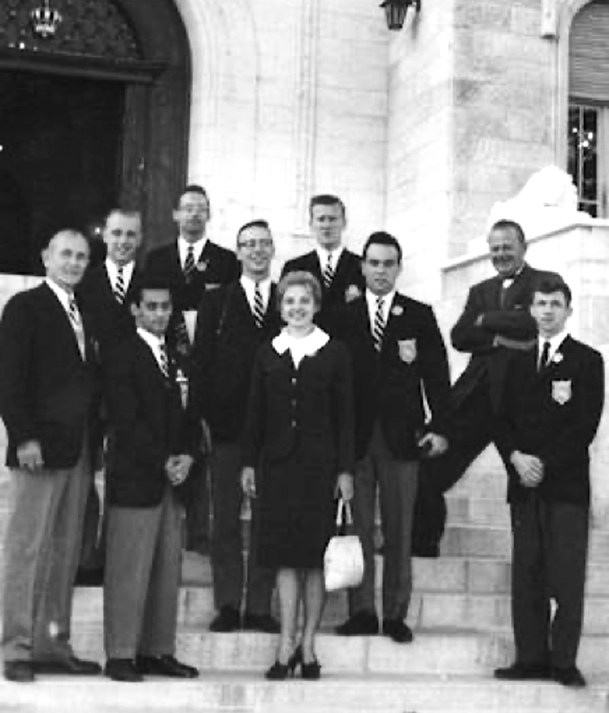
In mid-February of 1961, the US State Department sent a gymnastic and trampoline contingent to the Near East for a long goodwill tour. Muriel and Abie Grossfeld, the celebrated Olympic couple, along with at least seven other American athletes (Don Tonry, Bill Buck, Marshall Klaus, Larry Snyder, Armando Vega, Gar O’Quinn and Jamile “Jay” Ashmore) went to Turkey, Cyprus, Lebanon, Jordan, Syria, Kuwait, Pakistan and Bangladesh. Muriel was the only woman. The equipment and exhibition conditions were often crude and difficult. Just about everyone got sick or hurt. Muriel became quite ill in Pakistan with what was diagnosed as a non-recurrent form of malaria. Muriel and Abie had an audience with the young and handsome King Hussein of Jordan, the highlight of the tour.
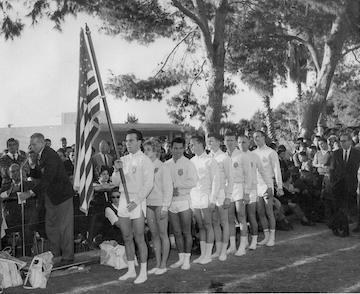
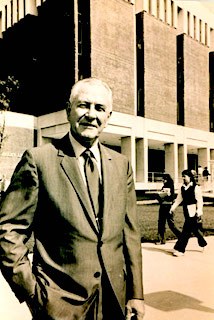
The married, two-time Olympians discussed the possibilities of making their third Olympic Games team. Abie was completing his Masters degree from the University of Illinois and Muriel needed a qualified coach to help her training. In the fall of 1962, along with several other Olympians and national champions, they began training at Southern Connecticut State College (SCSC) in New Haven at the invitation of SCSC President Hilton C. Buley. Abie took a coaching job at the Coast Guard Academy in New London, CT. Otto Graham, the legendary football quarterback, was Abie’s boss and the Athletic Director. Don Tonry took the coaching job at Yale University. Jay Ashmore, 1959 Pan American Games gold medalist, was on a graduate assistantship at SCSC. Olympian Doris Fuchs Brause, national tumbling champion Barbara Galleher, and the 1964 NCAA pommel horse champion Russell Mills of Yale University rounded out the impressive group of gymnasts training at this new “gymnastics Mecca.”
In 1962, Muriel won the Amateur Athletic Union (AAU) National titles on floor exercise and balance beam. The World Championships (WC) in Prague were also a success for Muriel. She finished 31st in the all-around leading the US team. The US women’s team finished eighth out of 17 countries competing. The US men were sixth out of 20 countries competing. This was the first WC for the US women.
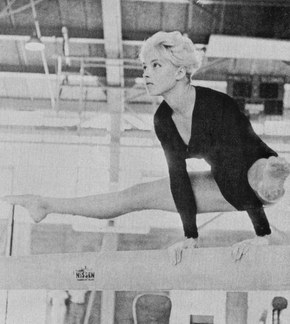
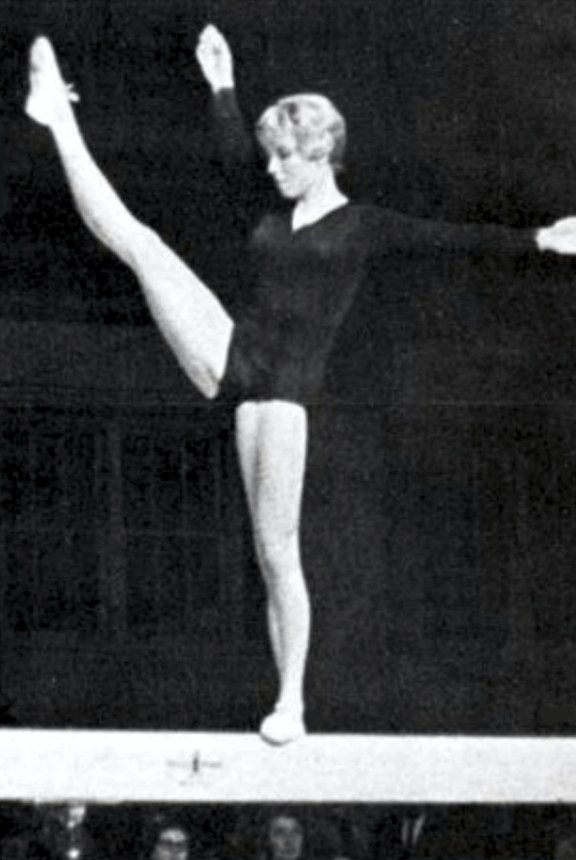

In 1963, Muriel and Abie, along with Don Tonry, Doris Fuchs Brause and Jay Ashmore successfully competed in the Pan American Games. The US dominated the competition in spite of judging that was atrocious. Importantly, the US won the men’s and women’s team titles holding off both the Canadians and the Cubans.
The sixties were a pivotal time for change in the history of gymnastics in the United States. Led by Harold “Hal” Frey, several courageous men’s collegiate gymnastics coaches created the new United States Gymnastics Federation (USGF) in December of 1962 with the hope of replacing the AAU as the ruling body for gymnastics in the United States. The AAU was an umbrella organization in charge of 13 US sports. Swimming, track & field and basketball were the favorites. The AAU continued to ignore the “unimportant sport of gymnastics.” Gymnastics was directed by a dual USGF-AAU arrangement of 10 members with an alternating chair from the two organizations called “the Commission” during the last years of the decade. The USGF gradually gained traction during the sixties. The USGF hired Frank Bare as their Executive Director who administered his organization from his “notorious kitchen office” in Tucson, Arizona. Bare used a printing press donated by Porter Equipment to print materials for his and other sports groups including the first International Gymnastics Federation (FIG) Code of Points in English.
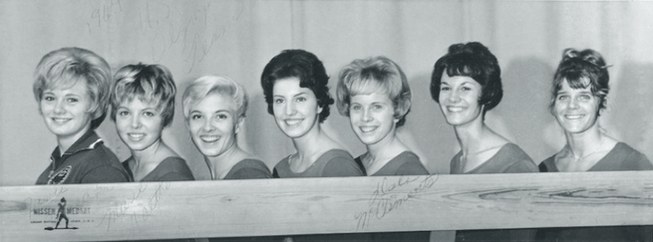
The Tokyo 1964 Olympic Games team selection process epitomized the problem of the AAU being the ruling body for the sport of gymnastics. The AAU gymnastics chairman, George Gulack, selected the internationally inexperienced Mr. Vannie Edwards as the women’s 1964 Olympic team coach. Gulack appointed his wife, Fay Gulack, who was incapable and unknowledgeable about gymnastics, as the team manager. It was an arrangement destined for disaster! George Gulack was hoping to remove certain gymnasts that he personally did not like from the competition team. Fay and Vannie did his bidding and pressured Muriel and Doris on his directive. Team members Dale McClements and Marie Walther were solid gymnastics performers with experience. Seventeen-year-old Linda Metheny was sensational and would also become a three-time Olympian. (Muriel and Abie had both helped develop Linda and her coach Dick Mulvihill in Illinois during Linda’s early training days.) Kathy Corrigan was the original team alternate because she had the lowest score of the seven team gymnasts from the final trials. The 16-year-old Janie Speaks, who was personally coached by Vannie Edwards, was young and inexperienced at best, but had tied Doris for fifth in the final trials. Fay and Vannie arranged a pre-Olympic intra-squad competition held in Tokyo the day before the competition for only four team members (Fuchs Brause, Grossfeld, Speaks, and the alternate, Kathy Corrigan). They then decided to remove Doris Fuchs Brause, two-time Olympian and the 1963 Pan Am Games all-around champion, from the competition team in favor of Corrigan. Doris was relegated to the position of alternate and “team spotter” for the US gymnasts during competition. This was needed because Olympic gymnastics competition rules at that time forbade the presence of a male coach (Edwards) on the competition floor. The incompetent Fay Gulack with her pompadour hairdo, high heels and a tight skirt, did not know how to spot or assist the women gymnasts. This left Doris to do the work of the coach. The “Gulack action” might have been considered palatable except that the “washed up” Doris Fuchs Brause went on to become the 1965 AAU National all-around Champion winning three of the four individual gymnastic events along the way. Then Doris made the 1966 World Championship team to Dortmund, Germany where she performed an optional uneven parallel bar routine that included the back uprise free hip mount on the high bar and the front straddle somersault flip from low to high bar. The latter was named “The Brause” after Doris who performed the move successfully during the international competition. Her routine was considered “ahead of its time.” Doris even held on in competition to place 5th at the 1968 Olympic Trials, whereas Janie Speaks did not make any more US international teams. What an unjust tragedy!
The men’s team selection process was also manipulated by George Gulack. Additionally, an inadequate team unity training plan and John Muir, an inexperienced international gymnastics team coach, could not coordinate a talented US men’s gymnastics team. Rusty Mitchell, the young USGF tumbling sensation; Californian Ron Barak; and the 17-year-old high school perfectionist, Makoto Sakamoto made the 1964 Olympic team along with veterans Art Shurlock, Larry Banner, and Gregor “Greg” Weiss. Three-time Olympian Jack Beckner, two-time Olympian Abie Grossfeld, and Olympian Don Tonry all fell short of making the team. The injured two-time Olympian Armando Vega held on as the team alternate. Unfortunately, Barak, the lawyer-to-be, and Mitchell, who executed the first double back during floor exercise in Olympic games history, retired from the sport after their first Olympics. Only Sakamoto went on with a long dedicated career in gymnastics international competition.
In any case, the US men’s and women’s 1964 Olympic teams failed to achieve the success they expected with seventh and ninth place team finishes, respectively. After the Tokyo Olympics, Muriel’s and Abie’s retirements from gymnastics competition were eminent. A fierce political battle challenging the AAU dictatorial leadership (Gulack and company) was ensuing. It was a chance to create better opportunities for American gymnasts. Muriel and Abie, Linda Metheny’s coach Dick Mulvihill, the new young lawyer Ron Barak, and many others all put their gymnastics careers on the line to combat the AAU gymnastics leadership and some of their corrupt practices. The final result of this eight-year political battle would be the installation of the USGF as the official US representative organization to the FIG Congress in 1970.
Muriel’s lifetime competition record stands among the best of American women gymnasts! She won 18 AAU National titles, made 3 Olympic teams,1World Championship team and 1 Pan American Games team. Her total of 18 AAU National titles is among the best in US gymnastics history.
What was ahead for Muriel and Abie now that their competition life was over? For Muriel it was judging, coaching and the promotion of physical fitness and gymnastics in the United States. For Abie, it was a prosperous SCSC collegiate and international coaching career that includes a gold team medal for the US men in the 1984 Olympic Games. But, Muriel and Abie would pursue their achievements independently. The Grossfeld’s quietly divorced in 1966.
Coming soon
Part 4 Muriel Grossfeld-A Special Team-Dortmund 1966 & Club 15
← Part 1: The Dolly Who Became an Olympian · ← Part 2: The Olympic Experience Continues – Rome