
The Florida State University Gymnastics Dynasty
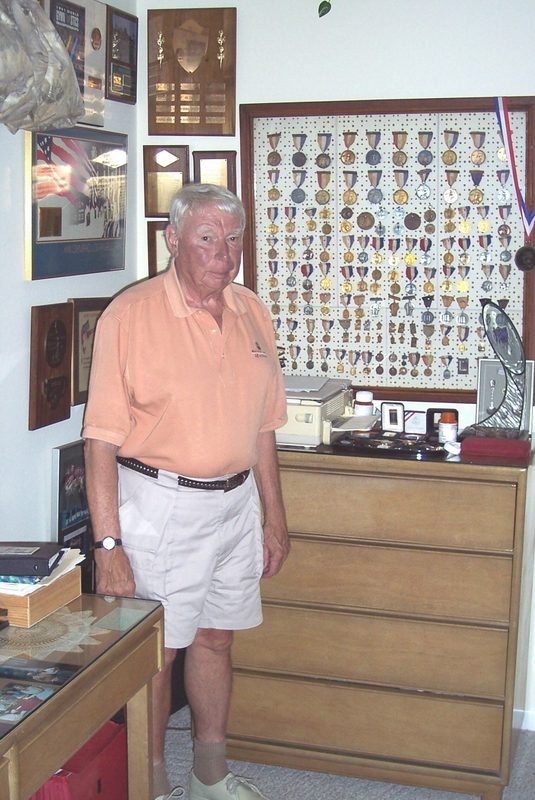
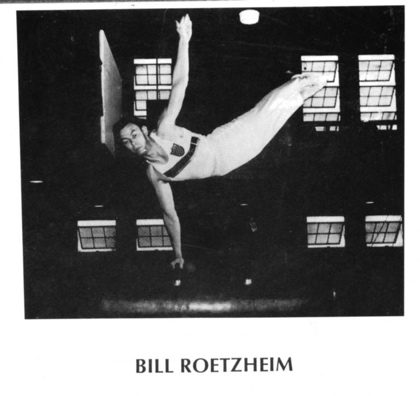
Bill Roetzheim was a 1948 and 1952 Olympian who won 7 NAAU titles and 2 NCAA titles. He was a successful coach at Proviso East High School in Illinois, 1955-69, a successful collegiate coach, and an innovative Athletic Director at the University of Illinois Chicago Circle. Roetzheim, a highly qualified gymnastics judge, was the first American to serve on the International Federation of Gymnastics (FIG) Technical Committee from 1984-1996. Bill was the fifth honoree of the National Gymnastics Judges Association (NGJA) and a 1975 honoree of the USA Gymnastics Hall of Fame. Most importantly for Bill, he was a great father of three children and a loving husband.
Becoming a Gymnast and an Olympian
Roetzheim’s father, a sports enthusiast and the chief building inspector/supervisor for the City of Chicago, took young Bill to the premier showing of Leni Riefenstahl’s 1936 classic film, Olympia, recording the history of the Berlin Olympics. Bill was attracted to gymnastics thereafter and his father enrolled him at the Southside Turners where he developed his gymnastics skills under Jim Rozanas. During his high school years, Henry Smidl coached him. At age eighteen, Bill became the youngest American male gymnast in history to make an Olympic team. Roetzheim competed in the 1948 Olympic games in London. This was the first Olympics following World War II and the gymnastics competition was conducted indoors at Empress Hall due to excessive rainfall that had interrupted the games and delayed the gymnastics competition for three days. The United States men’s team finished 5th of 5 teams competing. The U.S. women finished 3rd earning a bronze medal. Bill’s teammate, Frank Cumiskey, placed fourth on pommel horse and Clara Scroth won a bronze medal in vaulting.
An Eligibility Ruling Changes Bill’s Direction
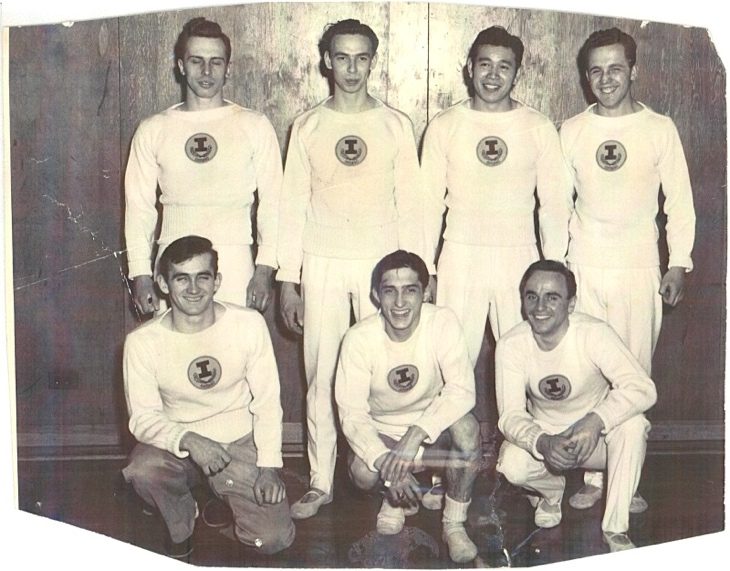
Bill returned home after the London games and attended the University of Illinois at Navy Pier where Hal Frey coached him. He won the 1949 NAAU all-around title and the team title. Roetzheim was ready to transfer to the University of Illinois’s main campus in Campaign/Urbana when the University of Illinois made an unusual eligibility ruling. Bill and other transfer athletes would have to wait out one year before becoming eligible for intercollegiate athletics because Navy Pier was deemed as a separate entity from the University of Illinois.
Hartley Price Goes to Tallahassee
Dr. Hartley “Hart” Price, a native of Australia, and the winner of four NCAA and two NAAU titles while the head gymnastics coach of the University of Illinois (1930-42), volunteered for the U.S. Navy at the outbreak of WWII. After the war, Price was discharged from the service (Navy V-5 Pilot Training Program at the University of Iowa and St. Mary’s of California) and went on to earn his doctorate at New York University in 1946. Hart was weighing his various job offers when Dr. Howard Danford, the new Athletic Director at Florida State University, offered him a faculty position. Price and his wife Billie were invited to visit Tallahassee and they immediately fell in love with the area landscape. The Prices were looking for a location with a warmer climate and Tallahassee met that requirement.
Roetzheim Decides on Florida State University
Price was well aware of Bill and was actively recruiting him. Bill decided to go to Florida State because there was no transfer penalty so he would be eligible to compete immediately. Roetzheim was already at FSU when he won the 1950 NAAU All-around title at UCLA May 8-9 and earned his selection for the Japan trip May 18-28.
The Origin of Florida State University
Francis Wayles Eppes left South Carolina to purchase land with rich soil in Florida for cotton planting. He championed education in Florida. Eppes, Thomas Jefferson’s grandson, founded the women’s and men’s seminary schools in Florida in 1851. Fifty -two years later, in 1903, the Buckman Act was passed by the Florida legislature to re-organize higher education in Florida into three institutions. The women’s seminary became the Florida State College for Women. The men’s seminary became the University of Florida, and Florida A & M was established for black students. As WWII ended, veterans taking advantage of the newly passed GI Bill of Rights would cause a surge in college enrollment in Florida. The Florida legislature declared Florida State College for Women to be co-ed in 1947 to accommodate the enrollment surge of men. Danford began to develop a well-rounded athletic program.
American Gymnasts go to Japan
Three American gymnasts; Ed Scrobe, Joe Kotys, and Bill Roetzheim were invited to Japan based on the NAAU meet results of 1950 for a goodwill tour including competition. General George MacArthur served as the American Olympic Committee Chairman in 1928. From 1945-51 he served as the overseer of Japan after the war. The three American gymnasts received a personal visit from MacArthur. They competed against the legendary Masao Takemoto who was 10 years Bill’s senior. The gymnasts went on a whirlwind tour of Japan performing exhibitions with the Japanese team along the way. In 1950 who would have predicted then that Japan would win five consecutive Olympic games gymnastics team titles from 1960-1976.
The 1951 Pan American Games of Buenos Aires
World War II had caused delays in scheduling the first Pan American Games (PAGs. The first Pan American Games were held in Buenos Aires, Argentina February 25th –March 9th of 1951. Juan Peron was President of Argentina. Peron and his wife Eva opened the games. Bill was the only American gymnast to go to the games and his father financed his trip. Roetzheim did not disappoint. Bill won the all-around and horizontal bar, placed second on pommel horse and floor exercise, and placed third on parallel bars and vaulting. Bill’s all-around score was 111.3. What else happened to Bill in Buenos Aires?
‘Two of Uncle Sam’s Athletes Spy on Peron’
Bill had met Stan Stanczyk, the 1948 Olympic games 181 pound gold medalist in weight lifting, during the London Olympics. In Buenos Aires, when Bill was housed with the weightlifting team. Stan and Bill won their gold medals during the first days o the PAG fand decided it was time to go to downtown Buenos Aires for some sightseeing. They stepped out of the barb-wired village area onto the train platform to take them downtown. Argentine military were posted around the compound and the train station. Stanczyk started clowning with an Argentinean solider and asked Bill to take a picture of the solider pointing his rifle at Stan. Bill obliged and the pair got on the train. The train left the station but soon was slowing down. Bill and Stan observed troop carriers riding along each side of the train. Military boarded the train and they were looking for the camera that Bill used to take the picture. Bill and Stan were taken in for interrogation. Bill slipped the film out of his camera while alone in the room where he had been taken to for questioning. He did not want to give up his film because, after all, he had pictures that he had taken of the U.S. pole vault champion Bob Richards on his roll of film. Roetzheim was observed through a two-way mirror and was relieved of the film. Just about then the American Consulate showed up and Bill was quickly put on a flight to Santiago, Chile for a flight back to the U.S. Once on board the flight to the U.S., a gentleman seated next to Bill commented to Bill that Bill looked real-tired, unshaven and basically disheveled. The passenger was none other than the famous Hollywood actor Joel McCrea. McCrea informed Bill that he had a sleeping berth in the rear of the plane and that Bill should take advantage of it. Arriving in Tampa, Bill’s girlfriend Betty Jo’s (BJ) father, grabbed Bill and took him to a place that the media couldn’t locate him. “What kind of young man did you meet up there in Tallahassee BJ,” commented BJ’s father. The Tampa Tribune’s front-page headline that day was: “Uncle Sam has U.S. Athletes Spying on Peron.”
The 1951 NCAA Gymnastics Championship
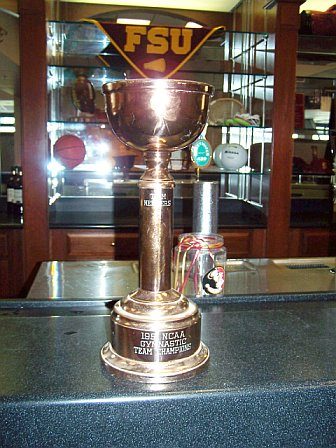
The 1951 NCAA Gymnastics Championship was held March 30-31 at the University of Michigan. Collegiate gymnastics was still developing at this time and the NAAU title was considered more prestigious than the NCAA title. Four FSU gymnasts: Bill Roetzheim, Carmine Regna, Joe Regna, and Bill Vrettos made up the FSU team for the NCAA meet. Bill scored all the points with the exception of Carmine Regna’s fifth place finish on horizontal bar. FSU won the meet with 26 points while Illinois and Southern California tied for second with 23.5 points. This was the first NCAA Championship in the state of Florida for any collegiate sport.
The 1951 NAAU Championship of Detroit
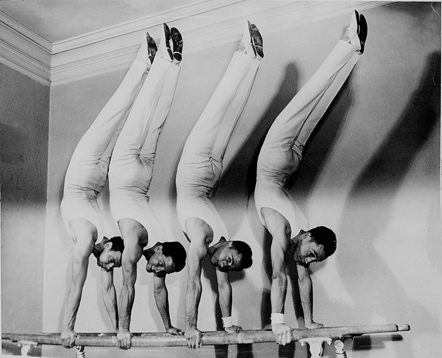
About five weeks after the NCAA Championship, FSU returned to Michigan for the NAAU Championships. FSU won the NAAU meet by a thirty-point margin scoring 53 points to 23.5 for the second place American Turners of the Bronx. Bill led the team with his third consecutive NAAU All-around title. He also earned NAAU titles on pommel horse and horizontal bar and a second place on parallel bars.
THE 1952 NAAU and Olympic Games Trials
The 1952 NAAU was also the Olympic games trials for the Helsinki Olympics held at Penn State University April 25-26. Bill finished 5th in the all-around and FSU was the second place team with 24.5 points compared to the Philadelphia Turners with 29 points. Bill was now in graduate school and he was ready to go to his second Olympic games.
The 1952 Olympic Games of Helsinki Finland
After the Olympic trials, the U.S. men’s team trained at the Army Academy at West Point. In Helsinki, the competition was held July 19-21 indoors at Messe Hall on Finnish equipment that was elevated three feet above the floor on an elevated Podium with 4,000 seats for spectators. Some of the equipment appeared irregular to the American team: rings with no straps, one end of the side horse longer than the other with high pommels and very springy parallel bars. The U.S. team ended eighth and Bill placed 59th in the all-around in a competition hosting 23 nations and 183 competitors.
American Olympic athletes were issued sleeping masks with their uniform paraphernalia because Finland is “the land of the midnight sun” and during the summer nights are short. However, Bill did not have his sleeping mask on when he was looking at an Olympic games medal count display at a famous department store in downtown Helsinki. He happened to be looking when the USSR suddenly jumped ahead of the U.S. in medal count. The USSR was entered their first Olympic games, and in gymnastics, proved to be the very best men’s and women’s gymnastics teams in Helsinki! Yes, the cold was on.
Coach of Proviso East High School of Illinois
Bill won three Illinois state high school championships and had 19 Illinois state champions. Roetzheim was instrumental in the formation of high school gymnastics in Illinois and has been inducted into Illinois High School Hall of Fame.
University of Illinois Chicago Circle
At the University of Illinois Chicago Circle, Bill amassed a dual meet record of 81 wins and 26 losses (.757 percentage) over five seasons. He coached three NCAA Champions and 19 individual All-Americans. Roetzheim established the Windy City Invitational, which was the oldest regular season men’s gymnastics event in the U.S. Bill’s team placed third in the NCAA Division II Championships once and fourth three times.
UIC Athletic Director 1974-1985
Roetzheim moved UIC toward Division I athletics from Division II with few resources and a lot of hard work. He was instrumental in the planning for the construction of the UIC Pavillion. Bill established programs that were in the best interest of the student body that have continued at UIC today.
Plant City Retirement
Bill and BJ retired to Plant City Florida after Bill’s retirement from UIC.
Bill was born September 7th 1928. Bill died February 26th 2014.
Written by Bruce Davis Professor Emeritus Miami Dade College Copywright 2010, revised 2026
The FSU Gymnastics Dynasty
Part 1: Dick Gutting · Part 2: Chick Cicio · Ron Galimore · All FSU stories